

Trial is not the only possible path after an assault charge in Texas. A plea agreement or pretrial diversion may offer an alternative, while self-defense arguments and challenges to the evidence can shape how the case proceeds. The right defense strategies for assault charges depend on what happened, what the evidence shows, and whether the prosecution can prove the alleged offense.
It is understandable to worry that an accusation alone will determine the outcome. But an accusation does not answer every legal question: the prosecutor decides whether to pursue charges, and an alleged victim’s recantation does not automatically end a domestic violence case. What matters is a careful review of the facts and available legal options.
This article explains how courts assess self-defense arguments, how a defense can challenge intent and unreliable evidence, and what pretrial resolutions may involve. It also explains why legal representation matters before you discuss the allegation or make decisions that could affect your case.
Key Takeaways
- Assess whether the response addressed an immediate threat and was proportionate, using available witnesses, video, and physical evidence to build context.
- Compare the prosecution’s evidence with each element it must prove, including intent, and look for inconsistencies or signs of accident or misunderstanding.
- Understand that an alleged victim’s wishes do not alone determine whether charges proceed; prosecutors decide whether to pursue a case.
- Consider whether consent, an alibi, or protecting another person may fit the facts and the law that applies to the charge.
- Preserve messages, photos, videos, and witness details, and get legal guidance before discussing the allegation with police or others involved.
1. Self-defense
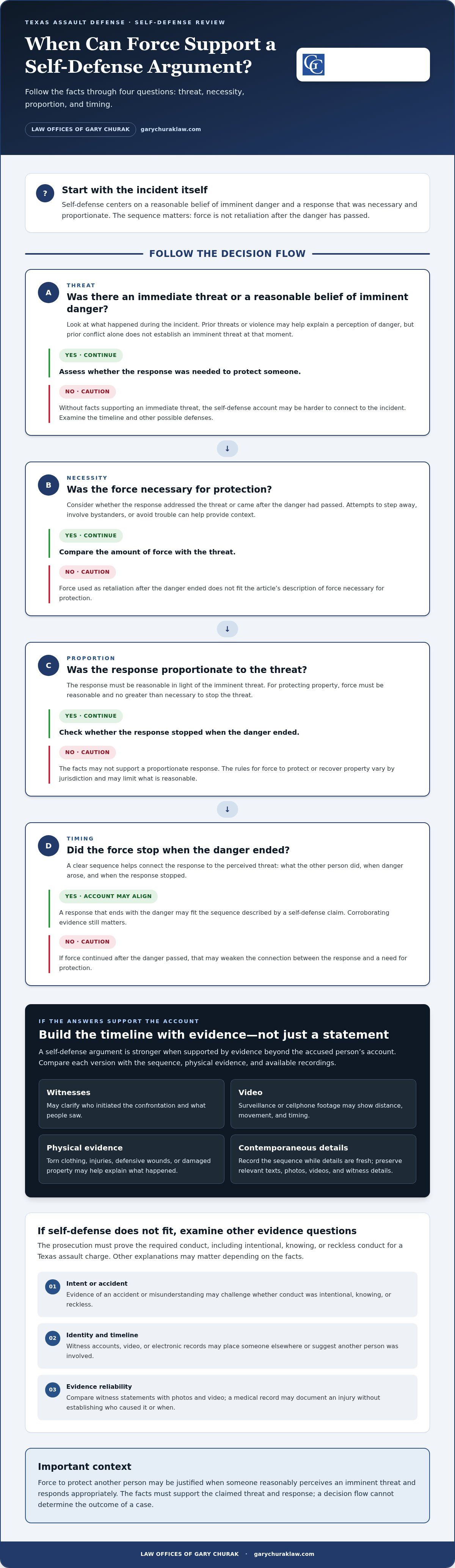
In Texas, self-defense centers on an immediate threat, a reasonable belief of imminent danger, and force proportionate to the threat. The response must be necessary for protection, not retaliation after the danger has passed. For example, evidence that someone tried to step away before using force may help explain why they believed harm was about to occur. The sequence matters.
Using force to protect another person may be justified when someone reasonably perceives an imminent threat and responds appropriately. The response must be reasonable in light of an imminent threat. Force to protect property must also be reasonable and no greater than necessary to stop the threat. The rules on using force to protect or recover property vary by jurisdiction and may limit what force is reasonable.
A self-defense argument is stronger when the account is supported by evidence beyond the accused person’s statement. Witness accounts may clarify who initiated the confrontation, while surveillance or cellphone footage can show distance, movement, and timing. Torn clothing, injuries, defensive wounds, or damaged property may also support a claim that the accused was attacked first or feared immediate harm.
Write down the sequence of events while the details are fresh. Record what the other person did, what threat seemed imminent, and how your response stopped when the danger ended. Preserve relevant texts, photos, and videos, and identify witnesses who saw the exchange. A changing account can make it harder to connect the response to a reasonable fear.
What happened before the confrontation can matter. Statements such as “I don’t want trouble,” attempts to walk away, or efforts to involve bystanders may support a claim that force was a last resort. Prior threats or violence by the alleged victim can help explain why someone perceived danger. These details need context: prior conflict alone does not establish an imminent threat during the incident.
Self-defense is one of several defense strategies for assault charges. Mistaken identity and lack of intent may fit different evidence. Video, electronic records, or witness accounts can place the accused elsewhere or suggest that someone else was involved. Evidence of an accident or misunderstanding may challenge whether the accused acted intentionally, knowingly, or recklessly, as a Texas assault allegation may require.
The prosecution must prove the required conduct, including intentional, knowing, or reckless conduct for a Texas assault charge. A self-defense claim challenges how the evidence should be understood, but the facts must support the claimed threat and response. Compare each account with the timeline, physical evidence, and available recordings. A clear account of who acted, when danger arose, and when force stopped can reveal gaps in the accusation.
2. Challenging whether evidence satisfies the elements of an offense
An assault allegation must be tested against the conduct the prosecution claims occurred. In Texas, assault may involve bodily injury, a threat of imminent harm, or offensive or provocative physical contact. The prosecution must prove intentional or reckless conduct. For example, an accidental collision in a crowded doorway may raise a different question from a deliberate shove. The surrounding words, movements, and timing help distinguish those accounts.
Compare each witness statement with the available timeline. A witness who first described a punch but later recalled a shove may have changed a material detail. That difference does not settle the case by itself, but it gives the defense a specific issue to investigate. A criminal defense attorney can compare interview accounts, testimony, photographs, and video to identify conflicts or missing context.
Physical evidence also requires careful scrutiny. A medical record may document an injury without establishing who caused it or when. A broken object might fit several explanations, while a weapon’s presence alone does not establish how it was used. Medical experts may assess injury causes and timelines; video analysts may examine security footage. Their review can test whether the prosecution’s interpretation fits the evidence.
Preserve original material as soon as possible. Save text messages with the surrounding conversation, keep original photos and videos, and note where each file came from. Write down which cameras may have recorded the incident and which witnesses were present. A short clip may omit what happened just before or after the visible moment, so investigators should seek the complete recording and compare its timestamps with other records.
Police procedures matter, too. Evidence obtained through an unlawful search or questioning that violated a person’s rights may be excluded from court. But not every disputed search or interview leads to suppression. The defense must examine how officers obtained the evidence, what happened during questioning, and whether the alleged violation applies to the material the prosecution intends to use.
These challenges may target reliability, admissibility, or whether the evidence proves a required element. In an aggravated assault case, the prosecution must prove every element beyond a reasonable doubt. If witnesses disagree about who held a weapon, or footage does not show the accused’s face, those gaps may weaken identification or the claimed sequence of events. A defense review should distinguish what evidence directly shows from what a witness or investigator infers.
If you’re facing an assault allegation, preserve evidence and avoid altering or circulating it. A focused assault charge evidence review can examine witness accounts, physical evidence, recordings, and possible constitutional issues before those details are lost.
3. Can assault charges be dropped before trial?
Yes. A prosecutor can dismiss an assault case before trial, and Texas cases may also resolve through a plea agreement or pretrial diversion. The alleged victim cannot personally dismiss criminal charges; the prosecutor decides whether to pursue them. A victim’s recantation alone does not automatically end a domestic violence case.
The prosecutor’s decision may depend on whether the evidence supports each element, whether witnesses remain available, and whether the case can be proved in court. Conflicting accounts, missing recordings, or evidence that contradicts the alleged timeline may prompt a reassessment. The defense can raise those weaknesses before trial through negotiations or pretrial hearings.
Definitions of simple assault differ by state. In Texas, assault can involve intentionally, knowingly, or recklessly causing bodily injury, threatening someone with imminent harm, or making contact understood as offensive or provocative. A simple assault allegation may center on a threat or contact. Prosecutors must prove the conduct and required mental state, not merely that an argument occurred.
Aggravated assault generally involves a serious factor, such as use of a deadly weapon, serious bodily injury, or an offense against a protected individual. The prosecution must prove every element of the charged offense beyond a reasonable doubt. A defense may challenge identification, intent, the alleged weapon’s use, or whether the evidence supports the claimed injury.
Penalties vary by state and offense level. In Florida, simple assault is a second-degree misdemeanor, punishable by up to 60 days in jail and a fine of up to $500. Florida aggravated assault is a third-degree felony, with up to five years in prison, probation, and a fine of up to $5,000. A Texas misdemeanor assault conviction can result in jail time of up to one year.
These examples show why the charge and jurisdiction matter. A felony allegation can carry more serious consequences than a misdemeanor, while aggravating factors can change the offense level. Missouri, for example, assigns separate statutes to first-, second-, third-, and fourth-degree assault. The statutory classification and alleged conduct shape the penalty range. Do not assume another state’s limits apply.
Domestic assault allegations involve a current or former spouse, dating partner, family member, or household member, and may trigger domestic violence proceedings. The relationship can affect how the case is handled, but it does not replace the need to prove the charged conduct. Preserve messages, photographs, and witness details, and follow any no-contact or release conditions.
Before trial, a prosecutor may consider dismissal, diversion, or a plea agreement. A plea may resolve the case with a different charge or outcome; diversion offers a route outside the trial process. Before deciding how to proceed, review the evidence, charge level, and conditions of any proposed resolution.
4. What Are the Legal Defenses Against an Assault Charge?
Consent may matter when the alleged contact occurred during an activity where participants accepted some physical contact. In sports, for example, a player who agrees to a lawful tackle may argue that the contact was part of the game. Whether consent applies, and how far it extends, varies by jurisdiction. It does not automatically cover conduct outside the activity’s accepted boundaries.
Build this defense around specific facts, not a general claim that “everyone agreed.” Identify the activity, its rules, the contact involved, and what happened immediately before and after. A game recording, referee’s account, or messages arranging the activity may help establish context. The key question is whether the alleged act fell within the consent given, not simply whether participants knew contact was possible.
Consent can be harder to assess when the parties disagree about what they agreed to. Someone may accept ordinary contact during a sport without agreeing to a separate attack after play stops. Likewise, agreement to one form of contact does not necessarily mean agreement to another. Witness statements, activity rules, and the sequence of events can help distinguish accepted contact from conduct that supports an assault allegation.
Other defenses may fit different facts. An alibi supported by records or witnesses can challenge whether the accused was present. Evidence of mistaken identity can raise questions about who acted, while an accident or misunderstanding may dispute criminal intent. In a group incident, examine what the accused personally did. Being present does not, by itself, establish each alleged action.
Possible consequences depend on the charge and jurisdiction. An assault conviction can bring fines, jail time, and a permanent criminal record. Aggravated assault may carry more serious consequences, including incarceration, probation, mandatory counseling, and a lasting record. These potential outcomes make it important to distinguish an accusation from a conviction and examine the evidence before choosing a response.
A criminal record can raise practical concerns beyond the courtroom. For example, someone facing a background review may need to address a conviction when an application asks about criminal history. An assault case can also strain family, workplace, or community relationships, especially when the alleged conduct involves someone the accused knows. The charge’s classification and final outcome shape which consequences apply.
In Texas, probation conditions may include anger management, avoiding the victim, and community service. Each condition can affect daily routines: a no-contact requirement may change communication, while service obligations require time. Read proposed conditions carefully and understand how they interact with work, caregiving, or shared responsibilities before accepting a resolution.
Before deciding whether consent or another defense fits, organize the evidence by event and source. Preserve messages, identify witnesses, and compare the alleged actions with the activity’s rules or agreed boundaries. These steps can clarify which defense addresses the specific conduct and what evidence may support it.
5. Criminal defense attorney representation
Facing a criminal assault allegation may require decisions before you fully understand the evidence. A defense attorney can assess the charge, explain the legal process, and identify steps to protect your rights. For example, an attorney can review the accusation alongside witness accounts, recordings, and the specific conduct the prosecution must prove.
Should you speak to police or accept a plea deal before consulting a criminal defense lawyer? No. Exercise your right to remain silent, and do not discuss the allegation with law enforcement before getting legal representation. Do not accept a plea deal before a lawyer reviews the charge, evidence, and proposed terms with you.
Early legal guidance can shape what happens at arraignment, pretrial hearings, and trial. An attorney can examine release conditions, explain court appearance requirements, and help you understand restrictions such as a no-contact order. Following those conditions matters while the case proceeds. If a condition affects necessary communication or daily responsibilities, get legal advice before acting.
A defense attorney can organize the investigation around specific questions. Who witnessed the event? Does available video show the full encounter? Do medical records support the alleged injury and timeline? Careful comparisons may reveal gaps or conflicts that affect the prosecution’s account. A medical expert or video analyst may assist with injury questions or footage review.
Before evaluating a plea offer, counsel can compare its terms with the evidence and the risks of continuing toward trial. That review should address the charged offense, any proposed lesser charge, and conditions attached to a resolution. A plea can have consequences beyond the immediate court result, including effects associated with a criminal record. Make the decision only after clearly understanding those terms.
Prepare for a legal consultation by creating a factual timeline and collecting relevant records. Save original texts, photographs, and videos; note potential witnesses and where recordings may exist. Keep your account factual, including details that may seem unfavorable. An accurate timeline helps counsel identify what needs investigation without relying on memory alone.
A criminal defense attorney can also help you avoid actions that complicate an assault case. Do not post about the arrest on social media, contact witnesses about their statements, or approach the alleged victim in violation of release conditions. Instead, preserve evidence and direct case-related communication through counsel. These steps can protect your position while the defense assesses the available options.
If you’re facing an assault charge, speak with a defense attorney about your case before discussing the allegation or deciding whether to accept a plea.
Law Offices of Gary Churak: DUI / DWI Defense
Law Offices of Gary Churak represents people facing assault allegations through its Assault & Battery Defense service. Turn to legal counsel when an arrest, investigation, or proposed plea makes the next decision difficult. A focused case review can examine the charged conduct, witness accounts, recordings, and whether the evidence supports the prosecution’s claims.
That review can also assess whether self-defense, mistaken identity, lack of intent, or another argument fits the available facts. Counsel can explain the options before trial and help you weigh a proposed resolution against the evidence and potential consequences. Early guidance can help you preserve relevant records and avoid statements that could complicate your case.
Contact Law Offices of Gary Churak to discuss your assault charge and next steps.
Take the Next Step With a Clear Plan
A charge can make every decision feel urgent, but a deliberate next step can help restore focus. Write down what you need clarified, any deadlines or court dates you are managing, and the decision you are being asked to make. This gives your next legal conversation a practical starting point and helps keep important concerns from going unspoken.
The defense strategies for assault charges that fit your situation depend on the evidence, the allegations, and the decisions ahead. Law Offices of Gary Churak handles Assault & Battery Defense, as well as DUI / DWI Defense and Drug Crimes Defense. A conversation about your case can help you understand the available options and prepare to make informed choices.
Contact Law Offices of Gary Churak to discuss your assault charge and next steps. You can move forward with a clearer plan, one decision at a time.
Frequently Asked Questions
Are there alternative resolutions besides going to trial?
Yes. In Texas, an assault case may resolve through a plea agreement or pretrial diversion instead of trial. Before considering either option, ask counsel to compare its terms with the charge, evidence, and required conditions. For example, a diversion offer may involve program requirements, so understand what participation entails and what may happen if you do not complete them. Assess any resolution against the facts and your priorities.
Can assault charges be dropped before trial?
Yes. A prosecutor may dismiss charges before trial, but the alleged victim does not control that decision. If the complainant changes their account, preserve relevant communications and share them with counsel rather than contacting them to coordinate statements. In domestic violence cases, a recantation does not automatically end proceedings. Prosecutors may consider the remaining evidence, including earlier statements or records, when deciding whether to continue the case.
What Are the Legal Defenses Against an Assault Charge?
Possible defenses include self-defense, defense of another person, consent where applicable, mistaken identity, lack of intent, and insufficient evidence. The facts determine which argument fits. For example, a time-stamped receipt or work record may help support an alibi, while a witness’s description may raise questions about identification. Organize relevant records by date and source, then discuss how they relate to the specific accusation and applicable state law.
What if the other party doesn’t want to press charges?
The prosecutor, not the other party, decides whether to pursue criminal charges. A complainant’s preference may be relevant, but it does not automatically end the case. Do not ask the person to withdraw a complaint or change their statement, since contact could create further problems. Preserve any existing messages about the incident and let your attorney assess whether they are relevant to the defense.
What are common legal defenses to assault charges in the United States?
Common defense strategies for assault charges include self-defense, protecting another person, consent where recognized, alibi, mistaken identity, lack of intent, and challenges to the prosecution’s evidence. State law affects which defenses apply and what facts support them. For instance, a witness or electronic record may help establish that the accused was elsewhere. Match each potential defense to specific evidence rather than relying on a label alone.
How does self-defense apply to assault charges, and what must be proven?
Self-defense generally concerns whether a person reasonably believed an imminent unlawful threat required a necessary, proportionate response. The details matter: when the threat occurred, who initiated the confrontation, and whether the response continued after the danger ended. A witness, recording, or physical evidence may help establish that sequence. Because legal standards vary by state, assess the incident under the law governing the charge.
How can mistaken identity, lack of intent, or an accident support an assault defense?
Mistaken identity challenges whether the accused was the person who acted; lack of intent and accident question the alleged mental state or conduct. For example, a mistaken time or location in a witness account may conflict with a receipt or electronic record. An accidental collision may also differ from a deliberate act. Preserve original records and note their source so counsel can assess their reliability and relevance.
Can consent or mutual combat be a defense to assault charges?
Consent may support a defense in some jurisdictions, including when physical contact occurs during an activity such as sports. It does not automatically cover every act connected to that activity. “Mutual combat” is not a universal defense that erases an assault allegation; its significance depends on the law and facts. The activity’s rules, the parties’ agreement, and what happened before and after the contact may all matter.


